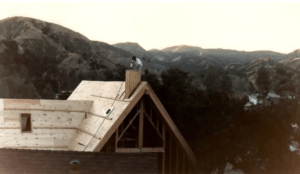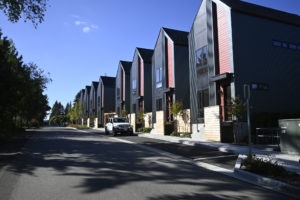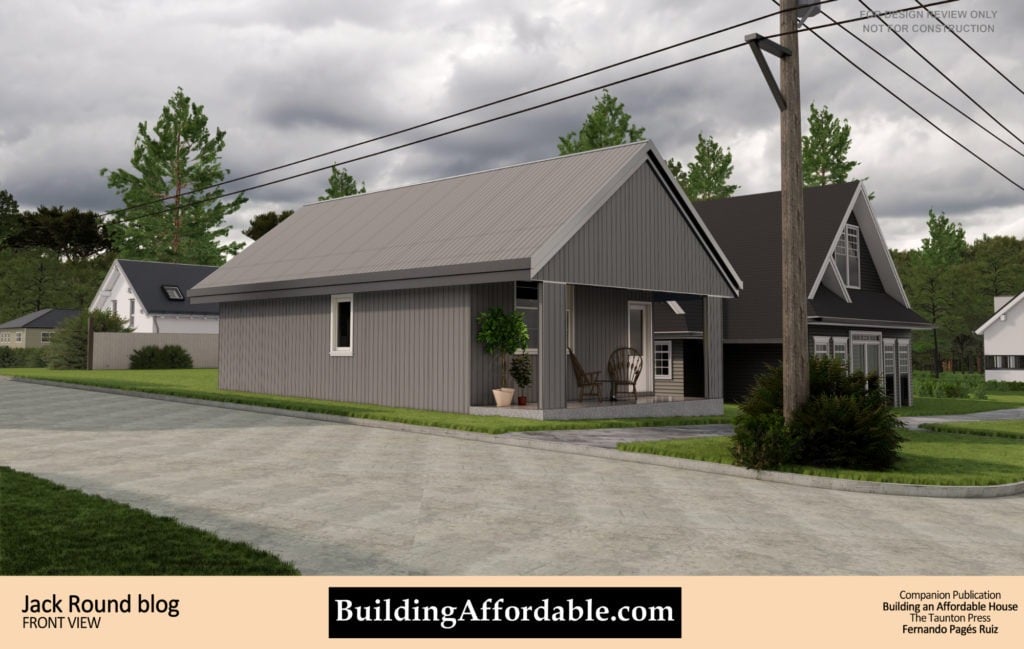
This North Omaha affordable house proves that real affordability comes from discipline, not gimmicks. Designed by Jack Round with Jeff Day’s office, the 602.5 square meter single story home sits on a Land Bank infill lot near 34th and Parker. It uses simple massing, a clean gable roof, slab on grade construction, advanced 2×6 framing at 24 inch spacing, standard windows, and factory painted steel siding and roofing. Every choice limits cost creep while keeping the house buildable by normal crews, not specialty contractors. The result is a small, durable, entry level home designed around real sale price, not architectural flexing.
Every few weeks someone sends me “an affordable house plan.” Usually that means a normal house with one or two gestures shaved off. Maybe the porch is smaller. Maybe they swap brick for lap siding. Then, almost inevitably, they add something back in: a pop-out, a fancy window, a quirky roof. The square footage creeps up. So does the cost.
Jack Round was different.
Jack is a former student. Last August he emailed: he had a permit set for a small house in North Omaha, on a Land Bank lot near 34th and Parker, just off the alley by Prospect Hill Cemetery. He wanted a budget reality check and offered to pay my consulting rate. That alone told me he was serious. I didn’t charge him.
I opened the drawings expecting to wince. Instead, I found myself thinking: he’s done it. This is the first set of plans I’ve seen in a long time that takes affordability as a hard boundary, not a marketing adjective.
What “getting it” looks like on paper
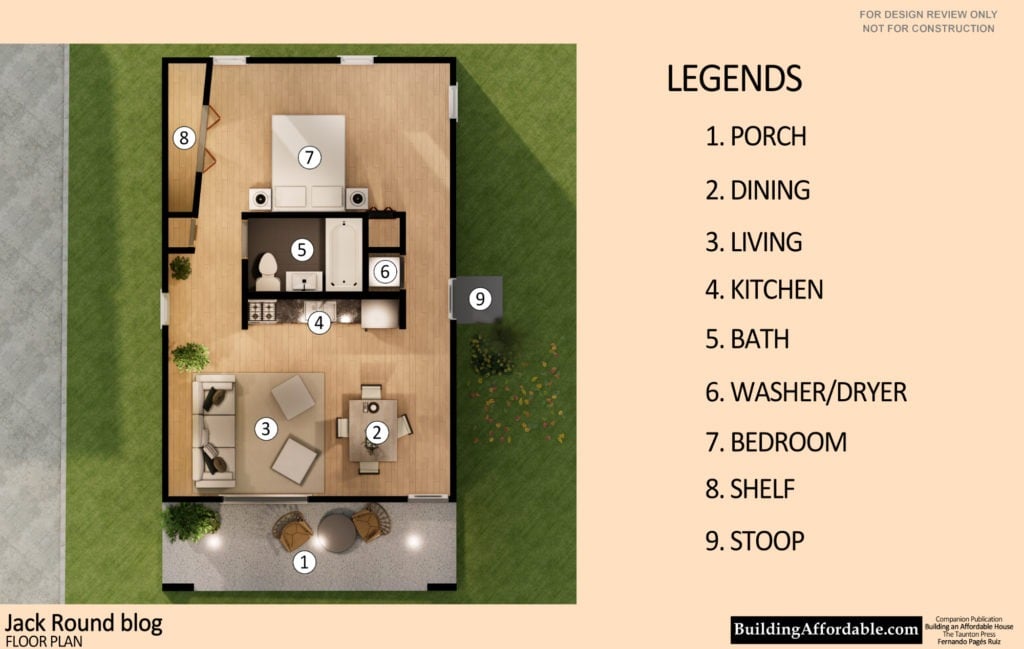
The North Omaha House is about 600 square feet—602.5, if you care about decimals. Single story. A simple gable roof. No jogged foundations, no gratuitous corners. Living, kitchen, and dining are one space. There’s a single bedroom and a bath, plus a front porch that’s modest but real. The footprint sits cleanly on a narrow infill lot, with parking off the alley.
Jack and his architect, Jeff Day’s office, didn’t just keep it small. They worked the assemblies:
- Slab-on-grade, frost-protected—no basement to leak, no stem walls to form, no stairs to frame.
- 2×6 advanced framing at 24″ o.c.—fewer studs, more insulation, less labor.
- One simple roof form with raised-heel trusses so the attic can actually be insulated to code-required R-values without gymnastics.
- Factory-painted steel siding and roofing—durable, low-maintenance skin you can buy off the rack at Menards.
- Standard-size windows dropped neatly into 24″ stud bays, not a custom light show.
Inside, the kitchen is a straight run. The bath is conventional. Mechanical equipment is equally straightforward: a wall-mounted mini-split, a small tankless water heater, and an honest electrical layout—nothing exotic, nothing boutique.
This is what designing for affordability looks like: simple massing, disciplined framing, and assemblies that any competent crew already knows how to build.
The courage not to “improve” the house
When I wrote to Andrés Duany about Jack’s plan, I tried to explain why I was impressed:
Most architects and clients can’t resist adding features that “improve” the house but quietly push costs higher. They don’t grasp the compounding effect.
They’ll say, “It’s only 10%.” But 10% is never insignificant. If the U.S. economy dipped 10%, we’d be in a revolution. Ten percent of a million is $100,000—a sum many Americans will never see all at once in their lifetime, let alone squander on luxuries. For Gen Z, 10% of $100,000 is the full down payment for an FHA loan. Saving that can take a decade.
Jack held the line. His house is small on purpose. The structure is straightforward on purpose. The finishes are simple on purpose. He is not designing for architectural juries; he is designing the actual sale price of an entry-level house in North Omaha. He is designing for people.
I believe he can build this house for under $100,000 in hard costs. That’s the breakthrough. Not some miracle component or subsidy, just relentless discipline.
About that angled wall
When I first walked through the plan set, one thing jumped out: an angled interior wall near the bedroom. I emailed him: “You certainly have done it, and few do. Would you explain the angled wall?” Jack’s answer was disarmingly honest: the angle is “just for architectural/visual interest.”
Normally, I’d fight that move. Geometry is not free. Angles complicate framing, flooring, drywall, trim, even the way furniture sits. Here, though, I see it as the one indulgence—an intentional deviation inside an otherwise brutally efficient plan. If you’re going to allow yourself a moment of expression, doing it with one wall, inboard of the envelope, is about as harmless as it gets.
The important thing is that he didn’t let that gesture snowball into a gallery of “special” details. One angle, not ten.
Why this house exists at all
Jack’s purpose is clear. As he told me:
- He wants a repeatable house that can be built on Omaha Land Bank lots in North Omaha.
- He sees it as a low-cost option for small clusters—say five houses—on underused land.
- In the long run, he imagines using the same model as the basis for a 20-unit cohousing community.
This isn’t a one-off art house. It’s a prototype for a small, durable, owner-occupied building that can work with local incomes and local construction capacity. The goal is not to impress the suburbs; it’s to be competitive with existing neighborhood prices so the project can pencil without contortions.
That mindset is rare. Most of the “affordable” proposals I see are quietly dependent on grants, philanthropy, or heroic general contractors willing to work for free. Jack is trying to close the math with normal money.
The real barrier: not design, but trades
If this were just a design story, I’d end here and declare victory. Jack drew a smart, small, buildable house. But my email exchanges with Jack tell a harder truth:
“We’ve had a hard time getting trades (plumbing, electrical, concrete) to respond.”
That line should worry anyone who cares about affordable housing. The obstacle is no longer just lazy design or bad detailing. It’s a trade base that has more work than it can handle, at higher margins, in easier parts of town.
A 600-square-foot house in North Omaha is not an attractive contract for most plumbers, electricians, or flatwork crews. They can make more money, with less perceived risk, roughing in a custom home on the edge of town. The labor market is telling us what it values.
You can design the perfect affordable house. Without trades willing to build it at scale, it stays on paper.
Where it stands now
As I write this, I don’t yet know if Jack has been able to get the house out of the ground. I plan to write and ask: Did the bid come in? Did anyone pour the slab? Did the mini-split ever get installed?
Regardless of the answer, the project is worth documenting. The North Omaha House is a clean, technically sound template—small, durable, and realistic about cost. It’s exactly the kind of plan city land banks, community groups, and non-profit developers should have in their drawer when a lot opens up and someone says, “We need something we can actually build.”
I’m proud of Jack. He knows his stuff. More important, he’s willing to do the unglamorous work of trimming a house down to what it truly needs—and then stop. If more architects followed that discipline, “affordable housing” would be less of a slogan and more of a standard product on the shelf.
Also read: Why Self-Building Homes Matter for Both the Past and Future of Housing